
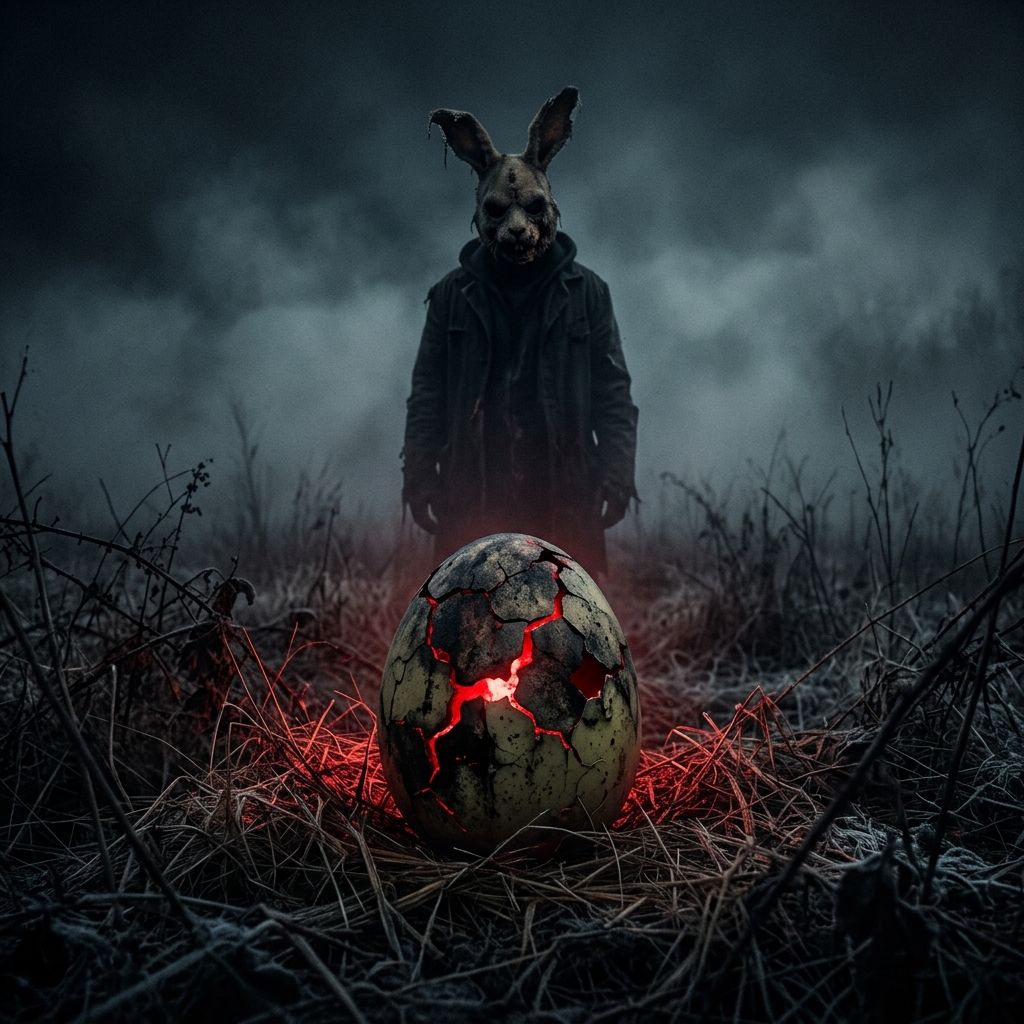

Happy Easter, you degenerates.
While the rest of the world hunts for pastel eggs and pretends the Resurrection isn't the most body-horror-adjacent event in Western mythology, we're doing what we always do: watching the worst things happen to the best people on the holiest day of the year.
Easter is ripe for horror. Think about it. The entire holiday is built on a corpse that won't stay dead, a ritual involving the symbolic consumption of flesh and blood, and a giant rabbit that breaks into your house at night. If that's not a horror premise, nothing is.
Here are five films that take Easter's latent dread and rip it open like a chocolate egg full of wasps.
1. Easter Bunny, Kill! Kill! (2006)
Let's start at the bottom and work our way up through the soil. Easter Bunny, Kill! Kill! is a grimy, no-budget exploitation film about a mentally disabled teenager whose caretaker hires a criminal to watch him on Easter Eve. What follows is a succession of home-invasion violence so mean-spirited it makes Last House on the Left look like a Hallmark special.
The "Easter Bunny" here is a masked vigilante dispensing justice with hammers, power drills, and whatever else is lying around the garage. It's ugly, it's relentless, and it has absolutely no business being as watchable as it is. Chad Ferrin directs like a man who knows no one will ever give him money again, and that desperation gives the film a feral energy most studio horror couldn't dream of.
Scare Factor: 🩸🩸🩸 — Not scary, but deeply unpleasant. Which is worse.
2. Critters 2: The Main Course (1988)
You forgot this one was an Easter movie, didn't you? Critters 2 opens with the Crites hatching from eggs that have been painted and hidden by the townsfolk of Grover's Bend for the town's Easter egg hunt. Children find alien eggs. Children bring alien eggs home. Alien eggs hatch. Chaos.
Mick Garris (who would later direct Sleepwalkers and The Stand) leans into the absurdity with a rolling Crite ball that devours an entire flock of sheep and a scene where the bounty hunters accidentally assume the form of a Playboy centerfold. It's goofy as hell, but it's also the only Easter-set horror film that managed to get a wide theatrical release. That deserves respect.
Scare Factor: 🩸🩸 — Family-friendly carnage. The gateway drug.
3. Absentia (2011)
Before The Haunting of Hill House, before Midnight Mass, Mike Flanagan made a $70,000 film about a woman whose husband vanished seven years ago and is about to be declared dead in absentia. Then he comes back. But something came back with him.
Easter doesn't appear on screen, but the film is structurally a resurrection story — and one of the most unsettling ones ever committed to film. Flanagan's signature trick is already fully formed here: he makes you feel grief before he makes you feel fear, so by the time the horror arrives, you're too emotionally invested to look away. The tunnel beneath the overpass is one of the great modern horror locations, and the creature design — or rather, the refusal of creature design — is masterful.
Scare Factor: 🩸🩸🩸🩸 — The kind of dread that follows you home.
4. The Resurrection of Jacob Wheeler (a.k.a. Live or Die, 2006)
This one's a deep cut. An anthology of short resurrection-themed horror films that circulated the festival circuit in the mid-2000s, anchored by a central narrative about a man who wakes up in his own coffin on Easter morning. The question isn't whether he's alive. The question is whether what woke him up is still in the coffin with him.
The production values vary wildly (it's an anthology — they always do), but the best segments tap into something genuinely primal: the fear that the dead aren't resting, and the deeper fear that we put them there before they were finished. If you can find it, it's worth the dig.
Scare Factor: 🩸🩸🩸 — Uneven, but the peaks are worth the valleys.
5. Calvaire (The Ordeal) (2004)
The crown jewel. Calvaire — French for "Calvary," the hill where Christ was crucified — is a Belgian-French-Luxembourgish folk horror film about a traveling entertainer whose van breaks down in the Ardennes and is taken in by a deranged innkeeper who becomes convinced the performer is his long-lost wife.
What follows is a Passion play performed by madmen. Du Welz constructs every scene like a Stations of the Cross painting dipped in mud and kerosene — the protagonist is stripped, humiliated, broken, and remade in the image of someone else's grief. The village dance scene is one of the most unnerving set pieces in 21st-century horror. No gore, no jump scares — just a roomful of broken men swaying to music that sounds like it's being played backwards.
Calvaire doesn't just use Easter as a setting. It uses it as a structural metaphor for suffering itself: the idea that you can be dragged through someone else's grief and emerge unrecognizable on the other side. That's not a holiday movie. That's an exorcism.
Scare Factor: 🩸🩸🩸🩸🩸 — This one stays.
THE COMMON THREAD
What makes Easter horror work — when it works — is the perversion of hope. Christmas horror inverts warmth. Halloween horror is just horror wearing a costume. But Easter horror takes the most optimistic premise in human civilization — death is not the end — and asks: what if that's the worst possible news?
Every film on this list, from the grimy to the transcendent, is wrestling with the same question: what comes back, and is it still the thing we loved?
Happy Easter. Lock your doors. And if something knocks three times, don't answer.
🐰🩸