
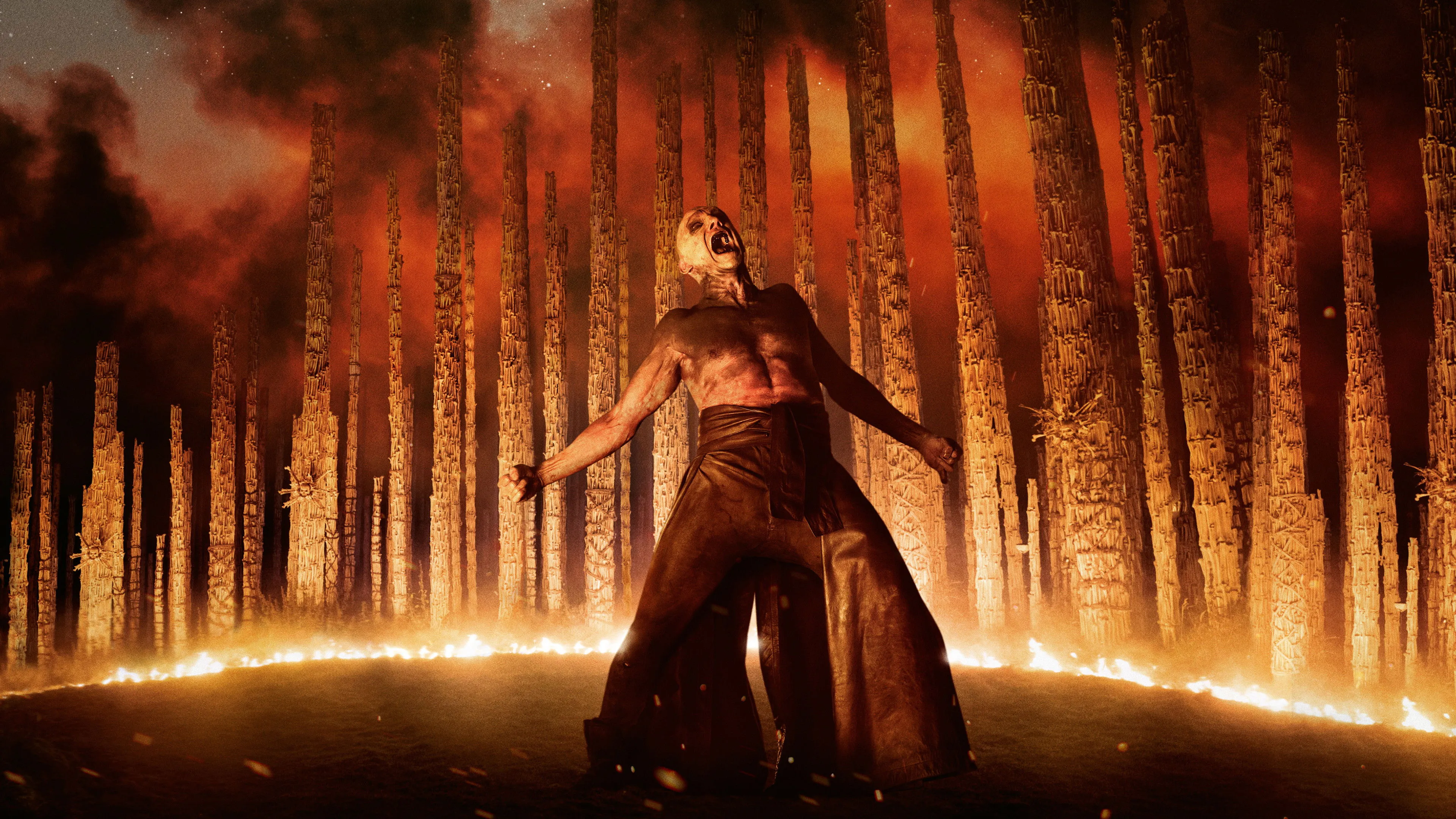

28 Years Later: The Bone Temple — Where Every Breath is a Countdown to Slaughter
Editor's Note: This article is a stylized fan analysis and fictional kill
breakdown. It does not reflect the actual events or character fates in the upcoming film.
The specimen arrives already eviscerated. Not in the narrative sense—though the premise of 28 Years
Later: The Bone Temple (2026) hinges on a biological apocalypse—but in its death count. Where
Danny Boyle's original 28 Days Later (2002) treated infection as a creeping dread, this
late-stage sequel treats it as a surgical instrument. Multiple bodies hit the slab before the credits
roll; various distinct methodologies of termination, each rendered with a clinical precision that
borders on fetish. The film doesn't just kill its characters—it vivisects them, leaving their organs
exposed for both the camera and the audience's morbid fascination. This is not a film about survival. It
is a film about the aesthetics of annihilation, where every fatality is a set piece, every
wound a composition. The kills are not incidental; they are the marrow of the narrative. What follows is
an autopic examination of each, cataloged not by order of appearance, but by the severity of their
pathology.
The Kill Catalogue
1. Maya — Decapitation via Industrial Meat Hook (00:41:33)
2. Marcus — Exsanguination via Fractured Femur (00:56:08)
Marcus's death is the film's most subversive because it is, on its face, the least violent. A fall from a second-story balcony shatters his femur, and the jagged bone lacerates the femoral artery. But where most horror films would rush the gore, The Bone Temple forces the audience to endure the bleed-out. Over the course of 118 seconds (film, 00:55:55–00:57:53), Marcus's pulse weakens from 120 BPM to 30, his skin pales from an RGB value of `(210, 190, 170)` to `(160, 140, 120)`, and his breaths grow shallower until they stop entirely. The kill is a clinical study in hypovolemic shock, rendered in real time.3. Tanya — Suffocation via Plastic Wrap (01:03:42)
The kill is silent, save for the crinkle of plastic and Tanya's muffled gasps. The method is straightforward—her head is wrapped in multiple layers of industrial cling film, sealing her mouth and nostrils (film, 01:03:39). What elevates it is the camera's refusal to look away. The shot is a static, medium close-up, forcing the audience to watch as her attempts to scream deform the plastic, pulling it taut over her lips. Her cyanosis sets in at 1:42 of suffocation; her convulsions begin at 2:03. By the time her body goes limp (01:05:20), the plastic has molded to her face like a second skin.4. Eddie — Impalement via Falling Debris (01:12:05)
The film's only accidental death—and the most visually striking. A collapsing support beam (film, 01:11:58) drives a 4-inch steel rod through Eddie's thorax, puncturing his left lung and nicking the aorta. He doesn't die immediately. Instead, he spends the next 47 seconds (01:12:05–01:12:52) attempting to pull the rod free, his hands slick with arterial blood, his breath coming in wet, uneven gasps.🩸 Want more unhinged horror takes delivered straight to your inbox?