
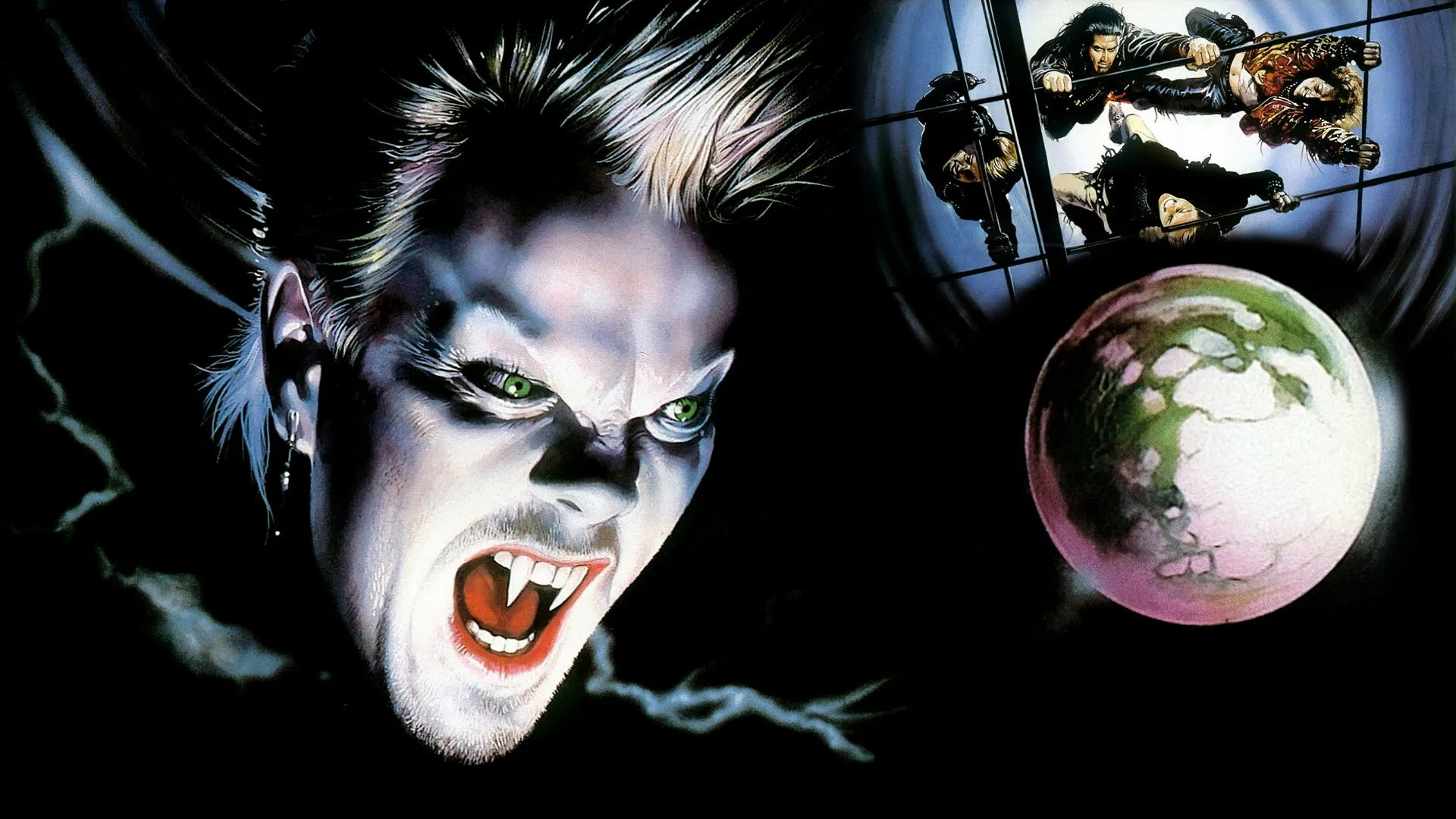

The Lost Boys Descend on Broadway: How the 1987 Vampire Mythos Got Its Fangs Back
When Joel Schumacher's The Lost Boys (1987) slithered into theaters in the dog days of summer, it didn't just redefine the vampire—it reanimated the corpse of 1980s youth culture itself, splicing neon-soaked aesthetics with the primal terror of eternal adolescence. That film, a high-camp horror-comedy with more hairspray than holy water, became a relic almost instantly, preserved in the amber of VHS rentals and late-night cable marathons. Now, thirty-seven years after Kiefer Sutherland's David first hissed "Welcome to Santa Carla" in that razor-sharp smirk, the lost boys are being exhumed—not for a reboot, not for a limited series, but for a Broadway musical. And if the recently unveiled posters are any indication, this isn't just an adaptation; it's an excavation of a lineage that horror has spent decades trying to either canonize or forget.The posters themselves are a study in franchise archaeology. One frames the Frog brothers—Sam and Edgar, the film's reluctant vampire hunters—in a neon-drenched alley, their oversized glasses reflecting the same sickly green glow that lit the original's vampire lair. The other isolates the pack: Michael (Corey Haim's would-be vampire), Star (Jami Gertz's ethereal love interest), and the undead quartet—David, Marko, Dwayne, and Paul—poised in a formation that mirrors the film's most iconic shot: the vampires perched on the cliffside, silhouetted against the moon like a gothic boy band. The typography, a jagged, comic-book-inspired font, doesn't just nod to the era—it screams it, as if the designers raided the same prop room that housed the title cards for Fright Night (1985) and The Monster Squad (1987). This is less a revival and more a restoration, a deliberate attempt to recapture the alchemy of a film that somehow balanced John Carpenter's nihilism with Richard Donner's earnestness, all while bathing it in the glow of a blacklight.
To understand why a Lost Boys musical isn't just a novelty but a potential inflection point for horror, you have to trace the lineage of the vampire on stage—a lineage that predates even Bela Lugosi's cape. The vampire has always been a theatrical creature, literally and figuratively. Long before Nosferatu (1922) or Dracula (1931), the undead were stalking the boards in 19th-century melodramas like Varney the Vampire (1847), where audiences hissed at villains who could only be killed by sunlight or stakes through the heart. By the time Hamilton Deane and John L. Balderston adapted Bram Stoker's novel for the stage in 1924, the vampire had already been enshrined as a figure of gothic spectacle—less a monster than a tragic antihero, doomed by his own appetites. That tradition carried into the 20th century with plays like Dracula: The Musical? (1995), a campy, off-Broadway affair that leaned into the same self-aware humor that The Lost Boys would later perfect. But where most vampire musicals treated the genre as a gimmick, The Lost Boys has the potential to treat it as a mythology—one that's been lurking in the cultural ossuary, waiting for the right production team to dust it off.
The key to this adaptation's success—or failure—lies in whether it can navigate the same tightrope Schumacher walked in 1987: balancing horror and humor without tipping into parody. The original film's genius was its refusal to commit to either extreme. It gave us a vampire who seduced his victims with a kiss, not a bite; a grandma who fought off the undead with a phone book; and a climax that hinged on something as absurd as a magazine subscription. Yet it also delivered visceral horror—David's death by sunlight, the vampires' lair dripping with gothic decay, the slow realization that Michael is becoming one of them. Translating that tonal whiplash to the stage is no small feat. Musicals thrive on spectacle, and horror thrives on intimacy. The risk is that the production will either become a hollow jukebox revue, all neon and no bite, or a grim, self-serious retread of a story that was never meant to be taken seriously. The posters suggest the former—bright, stylized, and more interested in aesthetic than atmosphere. But if the creative team (led by director Michael Greif, whose work on Rent and Dear Evan Hansen proves he understands the theater's power to both glamourize and gut-punch) can channel the film's anarchic energy, this could be the rare adaptation that doesn't just honor its source material but expands it.
What makes The Lost Boys uniquely suited for the stage, though, isn't its humor or its horror—it's its music. The original film's soundtrack was a character in itself, a mixtape of 1950s rockabilly, synth-pop, and post-punk that felt like it was transmitted from another dimension. The score, composed by Thomas Newman (before he became the go-to for prestige dramas), was a character in its own right, weaving together the film's disparate elements into a cohesive, dreamlike whole. If the musical can capture that same sonic magic, blending the iconic tracks with new compositions that evoke the same sense of timelessness and unease, it could be the key to unlocking a truly unforgettable theatrical experience.